




Anti-CD30L hIgG1 Antibody(Clone2)
货号
GM-88399AB
规格
10 μg
100 μg
1 mg
立即询价
数据展示
产品简介
相关产品
数据展示
Flow cytometry
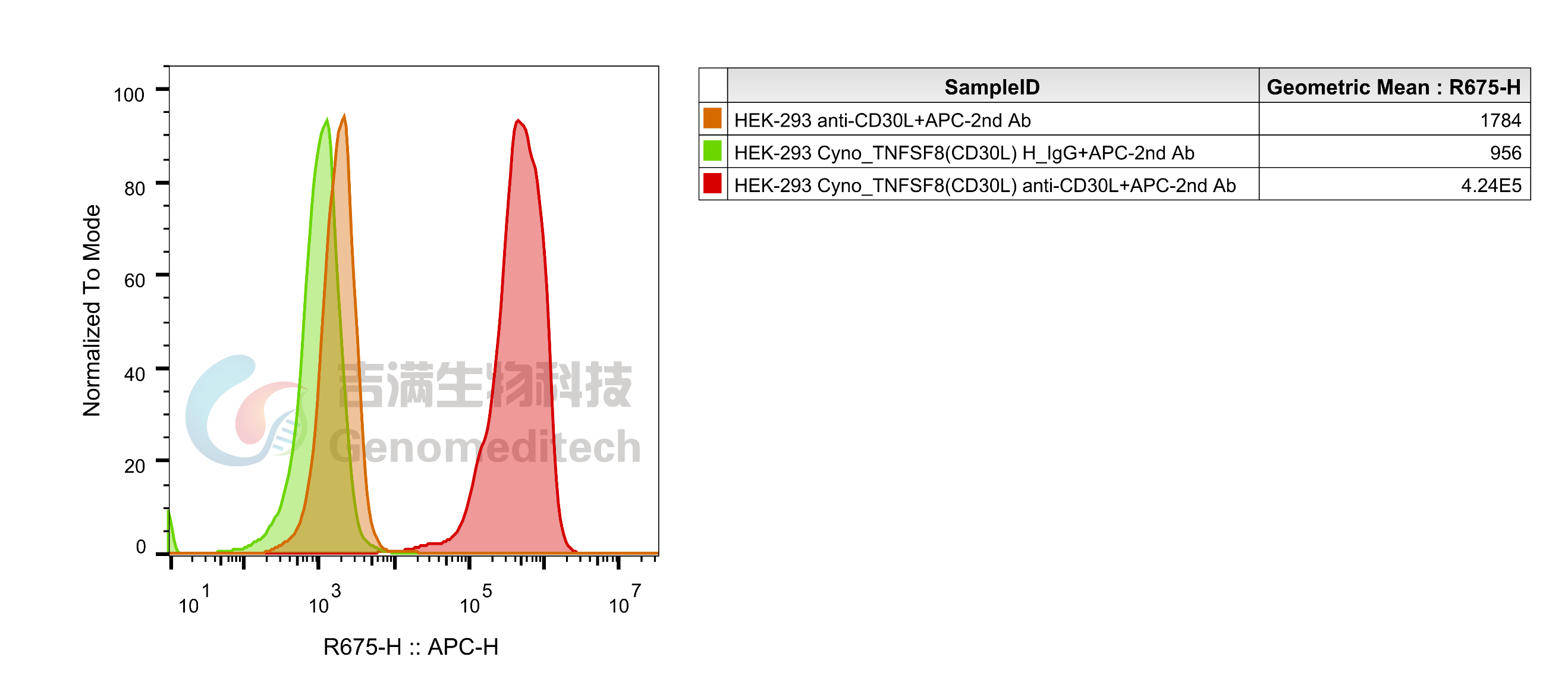
Cynomolgus_TNFSF8(CD30L) CHO Cell Line (Catalog # GM-C43849) was stained with Anti-CD30L hIgG1 Antibody(Clone2) (Catalog # GM-88399AB) or isotype control antibody, followed by anti-Human IgG APC-conjugated Secondary Antibody.
产品简介
Species Reactivity Cynomolgus
Clone Clone2
Source/Isotype Human IgG1(L234A,L235A,G237A), Kappa
Application Flow Cytometry
Specificity Detects CD30L
Gene CD30L
Other Names CD30-L,CD153,TNFSF8,CD30L,CD30LG,CD153 antigen,CD30 antigen ligand,CD30 Ligand
Gene ID 102143966 (Cynomolgus)
Background CD30L (CD153, TNFRSF8) , a type II transmembrane glycoprotein of tumor necrosis factor ligand superfamily member 8, is a key signaling axis for the development of tumor necrosis factors by binding to CD30(TNFRSF8) to form a critical signaling axis, which is essential for the development of tumor necrosis factors, it is also the key signaling axis of tumor necrosis factors and plays a central role in immune regulation and tumorigenesis. Its extracellular domain is hydrolysable to produce soluble SCD30L, which is involved in regulating inflammation and the tumor microenvironment. Functionally, CD30L activates NF-κb and MAPK PATHWAYS, promoting T/B cell activation, proliferation, and antibody production, while regulating the Th1/Th2 balance through chemokines (such as mip-1 α) and cytokines (such as IL-5) , which may play an important role in the regulation of T/B cell proliferation and antibody production, may play an important role in regulating T/B cell proliferation and antibody production, affecting immune escape. In Hodgkin's lymphoma, the CD30L signaling axis drives the survival of tumor cells such as Hodgkin's lymphoma (HL) , anaplastic large cell lymphoma (ALCL) , and diffuse large cell lymphoma (DLBCL) . Its high expression is associated with sustained activation of NF-κb, chromosomal instability, and poor prognosis. At the epigenetics level, CD30 promoter region CpG island hypomethylation and the regulation of transcription factors (such as JUNB, STAT3) promote its expression, while the regulation of CD30 promoter region CpG island hypermethylation promotes its expression, and the regulation of CD30 promoter region CpG island hypermethylation promotes its expression, superenhancers drive high expression of ALCL and adult t-cell leukemia/lymphoma (ATL) .
Storage Store at 2-8℃ short term (1-2 weeks).Store at ≤ -20℃ long term. Avoid repeated freeze-thaw.
Formulation Supplied as a 0.2 μm filtered solution of PBS, pH7.2-7.4.
Endotoxin < 1 EU/mg, determined by LAL gel clotting assay
Species Reactivity Cynomolgus
Clone Clone2
Source/Isotype Human IgG1(L234A,L235A,G237A), Kappa
Application Flow Cytometry
Specificity Detects CD30L
Gene CD30L
Other Names CD30-L,CD153,TNFSF8,CD30L,CD30LG,CD153 antigen,CD30 antigen ligand,CD30 Ligand
Gene ID 102143966 (Cynomolgus)
Background CD30L (CD153, TNFRSF8) , a type II transmembrane glycoprotein of tumor necrosis factor ligand superfamily member 8, is a key signaling axis for the development of tumor necrosis factors by binding to CD30(TNFRSF8) to form a critical signaling axis, which is essential for the development of tumor necrosis factors, it is also the key signaling axis of tumor necrosis factors and plays a central role in immune regulation and tumorigenesis. Its extracellular domain is hydrolysable to produce soluble SCD30L, which is involved in regulating inflammation and the tumor microenvironment. Functionally, CD30L activates NF-κb and MAPK PATHWAYS, promoting T/B cell activation, proliferation, and antibody production, while regulating the Th1/Th2 balance through chemokines (such as mip-1 α) and cytokines (such as IL-5) , which may play an important role in the regulation of T/B cell proliferation and antibody production, may play an important role in regulating T/B cell proliferation and antibody production, affecting immune escape. In Hodgkin's lymphoma, the CD30L signaling axis drives the survival of tumor cells such as Hodgkin's lymphoma (HL) , anaplastic large cell lymphoma (ALCL) , and diffuse large cell lymphoma (DLBCL) . Its high expression is associated with sustained activation of NF-κb, chromosomal instability, and poor prognosis. At the epigenetics level, CD30 promoter region CpG island hypomethylation and the regulation of transcription factors (such as JUNB, STAT3) promote its expression, while the regulation of CD30 promoter region CpG island hypermethylation promotes its expression, and the regulation of CD30 promoter region CpG island hypermethylation promotes its expression, superenhancers drive high expression of ALCL and adult t-cell leukemia/lymphoma (ATL) .
Storage Store at 2-8℃ short term (1-2 weeks).Store at ≤ -20℃ long term. Avoid repeated freeze-thaw.
Formulation Supplied as a 0.2 μm filtered solution of PBS, pH7.2-7.4.
Endotoxin < 1 EU/mg, determined by LAL gel clotting assay
相关产品
Anti-CD30L hIgG1 Antibody(Clone2)
货号
GM-88399AB
规格
10 μg
100 μg
1 mg
立即询价
数据展示
产品简介
相关产品
数据展示
Flow cytometry
Cynomolgus_TNFSF8(CD30L) CHO Cell Line (Catalog # GM-C43849) was stained with Anti-CD30L hIgG1 Antibody(Clone2) (Catalog # GM-88399AB) or isotype control antibody, followed by anti-Human IgG APC-conjugated Secondary Antibody.
产品简介
Species Reactivity Cynomolgus
Clone Clone2
Source/Isotype Human IgG1(L234A,L235A,G237A), Kappa
Application Flow Cytometry
Specificity Detects CD30L
Gene CD30L
Other Names CD30-L,CD153,TNFSF8,CD30L,CD30LG,CD153 antigen,CD30 antigen ligand,CD30 Ligand
Gene ID 102143966 (Cynomolgus)
Background CD30L (CD153, TNFRSF8) , a type II transmembrane glycoprotein of tumor necrosis factor ligand superfamily member 8, is a key signaling axis for the development of tumor necrosis factors by binding to CD30(TNFRSF8) to form a critical signaling axis, which is essential for the development of tumor necrosis factors, it is also the key signaling axis of tumor necrosis factors and plays a central role in immune regulation and tumorigenesis. Its extracellular domain is hydrolysable to produce soluble SCD30L, which is involved in regulating inflammation and the tumor microenvironment. Functionally, CD30L activates NF-κb and MAPK PATHWAYS, promoting T/B cell activation, proliferation, and antibody production, while regulating the Th1/Th2 balance through chemokines (such as mip-1 α) and cytokines (such as IL-5) , which may play an important role in the regulation of T/B cell proliferation and antibody production, may play an important role in regulating T/B cell proliferation and antibody production, affecting immune escape. In Hodgkin's lymphoma, the CD30L signaling axis drives the survival of tumor cells such as Hodgkin's lymphoma (HL) , anaplastic large cell lymphoma (ALCL) , and diffuse large cell lymphoma (DLBCL) . Its high expression is associated with sustained activation of NF-κb, chromosomal instability, and poor prognosis. At the epigenetics level, CD30 promoter region CpG island hypomethylation and the regulation of transcription factors (such as JUNB, STAT3) promote its expression, while the regulation of CD30 promoter region CpG island hypermethylation promotes its expression, and the regulation of CD30 promoter region CpG island hypermethylation promotes its expression, superenhancers drive high expression of ALCL and adult t-cell leukemia/lymphoma (ATL) .
Storage Store at 2-8℃ short term (1-2 weeks).Store at ≤ -20℃ long term. Avoid repeated freeze-thaw.
Formulation Supplied as a 0.2 μm filtered solution of PBS, pH7.2-7.4.
Endotoxin < 1 EU/mg, determined by LAL gel clotting assay
Species Reactivity Cynomolgus
Clone Clone2
Source/Isotype Human IgG1(L234A,L235A,G237A), Kappa
Application Flow Cytometry
Specificity Detects CD30L
Gene CD30L
Other Names CD30-L,CD153,TNFSF8,CD30L,CD30LG,CD153 antigen,CD30 antigen ligand,CD30 Ligand
Gene ID 102143966 (Cynomolgus)
Background CD30L (CD153, TNFRSF8) , a type II transmembrane glycoprotein of tumor necrosis factor ligand superfamily member 8, is a key signaling axis for the development of tumor necrosis factors by binding to CD30(TNFRSF8) to form a critical signaling axis, which is essential for the development of tumor necrosis factors, it is also the key signaling axis of tumor necrosis factors and plays a central role in immune regulation and tumorigenesis. Its extracellular domain is hydrolysable to produce soluble SCD30L, which is involved in regulating inflammation and the tumor microenvironment. Functionally, CD30L activates NF-κb and MAPK PATHWAYS, promoting T/B cell activation, proliferation, and antibody production, while regulating the Th1/Th2 balance through chemokines (such as mip-1 α) and cytokines (such as IL-5) , which may play an important role in the regulation of T/B cell proliferation and antibody production, may play an important role in regulating T/B cell proliferation and antibody production, affecting immune escape. In Hodgkin's lymphoma, the CD30L signaling axis drives the survival of tumor cells such as Hodgkin's lymphoma (HL) , anaplastic large cell lymphoma (ALCL) , and diffuse large cell lymphoma (DLBCL) . Its high expression is associated with sustained activation of NF-κb, chromosomal instability, and poor prognosis. At the epigenetics level, CD30 promoter region CpG island hypomethylation and the regulation of transcription factors (such as JUNB, STAT3) promote its expression, while the regulation of CD30 promoter region CpG island hypermethylation promotes its expression, and the regulation of CD30 promoter region CpG island hypermethylation promotes its expression, superenhancers drive high expression of ALCL and adult t-cell leukemia/lymphoma (ATL) .
Storage Store at 2-8℃ short term (1-2 weeks).Store at ≤ -20℃ long term. Avoid repeated freeze-thaw.
Formulation Supplied as a 0.2 μm filtered solution of PBS, pH7.2-7.4.
Endotoxin < 1 EU/mg, determined by LAL gel clotting assay
Species Reactivity Cynomolgus
Clone Clone2
Source/Isotype Human IgG1(L234A,L235A,G237A), Kappa
Application Flow Cytometry
Specificity Detects CD30L
Gene CD30L
Other Names CD30-L,CD153,TNFSF8,CD30L,CD30LG,CD153 antigen,CD30 antigen ligand,CD30 Ligand
Gene ID 102143966 (Cynomolgus)
Background CD30L (CD153, TNFRSF8) , a type II transmembrane glycoprotein of tumor necrosis factor ligand superfamily member 8, is a key signaling axis for the development of tumor necrosis factors by binding to CD30(TNFRSF8) to form a critical signaling axis, which is essential for the development of tumor necrosis factors, it is also the key signaling axis of tumor necrosis factors and plays a central role in immune regulation and tumorigenesis. Its extracellular domain is hydrolysable to produce soluble SCD30L, which is involved in regulating inflammation and the tumor microenvironment. Functionally, CD30L activates NF-κb and MAPK PATHWAYS, promoting T/B cell activation, proliferation, and antibody production, while regulating the Th1/Th2 balance through chemokines (such as mip-1 α) and cytokines (such as IL-5) , which may play an important role in the regulation of T/B cell proliferation and antibody production, may play an important role in regulating T/B cell proliferation and antibody production, affecting immune escape. In Hodgkin's lymphoma, the CD30L signaling axis drives the survival of tumor cells such as Hodgkin's lymphoma (HL) , anaplastic large cell lymphoma (ALCL) , and diffuse large cell lymphoma (DLBCL) . Its high expression is associated with sustained activation of NF-κb, chromosomal instability, and poor prognosis. At the epigenetics level, CD30 promoter region CpG island hypomethylation and the regulation of transcription factors (such as JUNB, STAT3) promote its expression, while the regulation of CD30 promoter region CpG island hypermethylation promotes its expression, and the regulation of CD30 promoter region CpG island hypermethylation promotes its expression, superenhancers drive high expression of ALCL and adult t-cell leukemia/lymphoma (ATL) .
Storage Store at 2-8℃ short term (1-2 weeks).Store at ≤ -20℃ long term. Avoid repeated freeze-thaw.
Formulation Supplied as a 0.2 μm filtered solution of PBS, pH7.2-7.4.
Endotoxin < 1 EU/mg, determined by LAL gel clotting assay
相关产品
Tel: 400-627-9288
留言咨询
重置
提交
客服
微信
电话
留言
留言咨询
重置
提交