







创新发现,从这里开始
Human TNFRSF8(CD30) Protein; hFc Tag
货号
GM-88427RP
规格
100 μg
1 mg
立即询价
产品简介
数据展示
相关产品
产品简介
Alternative Names TNFRSF8, CD30, D1S166E, Ki-1
Source Human TNFRSF8(CD30) Protein; hFc Tag (GM88427RP) is expressed from human 293 cells (HEK-293). It contains AA Phe 19 - Lys 379 (Accession # P28908-1).
This protein carries a hFc tag at the C-terminus.
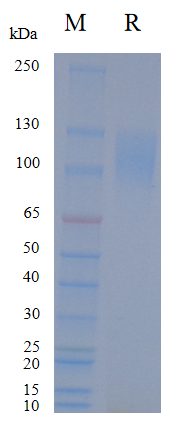
Purity > 95% as determined by SDS-PAGE
Endotoxin < 1 EU/μg, determined by LAL gel clotting assay
Predicted Mol Mass 64.4 KDa
Formulation Supplied as a 0.2 μm filtered solution of PBS, pH7.2-7.4.
Description TNFRSF8, also known as CD30, is a type I transmembrane receptor in the tumor necrosis factor receptor (TNFR) superfamily. It is variably expressed on activated T cells, certain B cells, and a subset of malignancies such as Hodgkin lymphoma and anaplastic large cell lymphoma. CD30 functions as a co-stimulatory receptor involved in cell proliferation, survival, and differentiation signals. It is also used as a diagnostic and therapeutic target in CD30-positive diseases. Other aliases include D1S166E and Ki-1.
CD30 signaling is initiated upon trimerization or clustering of the receptor, leading to recruitment of adaptor proteins and activation of downstream pathways such as NF-κB, MAPK (ERK, JNK), and PI3K-Akt. This signaling promotes cell survival, proliferation, and cytokine production, particularly in activated T cells and certain neoplastic cells. Dysregulated CD30 signaling can contribute to pathologic immune responses and tumorigenesis, making CD30 a valuable target for monoclonal antibodies and targeted therapies.

Alternative Names TNFRSF8, CD30, D1S166E, Ki-1
Source Human TNFRSF8(CD30) Protein; hFc Tag (GM88427RP) is expressed from human 293 cells (HEK-293). It contains AA Phe 19 - Lys 379 (Accession # P28908-1).
This protein carries a hFc tag at the C-terminus.
Purity > 95% as determined by SDS-PAGE
Endotoxin < 1 EU/μg, determined by LAL gel clotting assay
Predicted Mol Mass 64.4 KDa
Formulation Supplied as a 0.2 μm filtered solution of PBS, pH7.2-7.4.
Description TNFRSF8, also known as CD30, is a type I transmembrane receptor in the tumor necrosis factor receptor (TNFR) superfamily. It is variably expressed on activated T cells, certain B cells, and a subset of malignancies such as Hodgkin lymphoma and anaplastic large cell lymphoma. CD30 functions as a co-stimulatory receptor involved in cell proliferation, survival, and differentiation signals. It is also used as a diagnostic and therapeutic target in CD30-positive diseases. Other aliases include D1S166E and Ki-1.
CD30 signaling is initiated upon trimerization or clustering of the receptor, leading to recruitment of adaptor proteins and activation of downstream pathways such as NF-κB, MAPK (ERK, JNK), and PI3K-Akt. This signaling promotes cell survival, proliferation, and cytokine production, particularly in activated T cells and certain neoplastic cells. Dysregulated CD30 signaling can contribute to pathologic immune responses and tumorigenesis, making CD30 a valuable target for monoclonal antibodies and targeted therapies.

数据展示
纯度
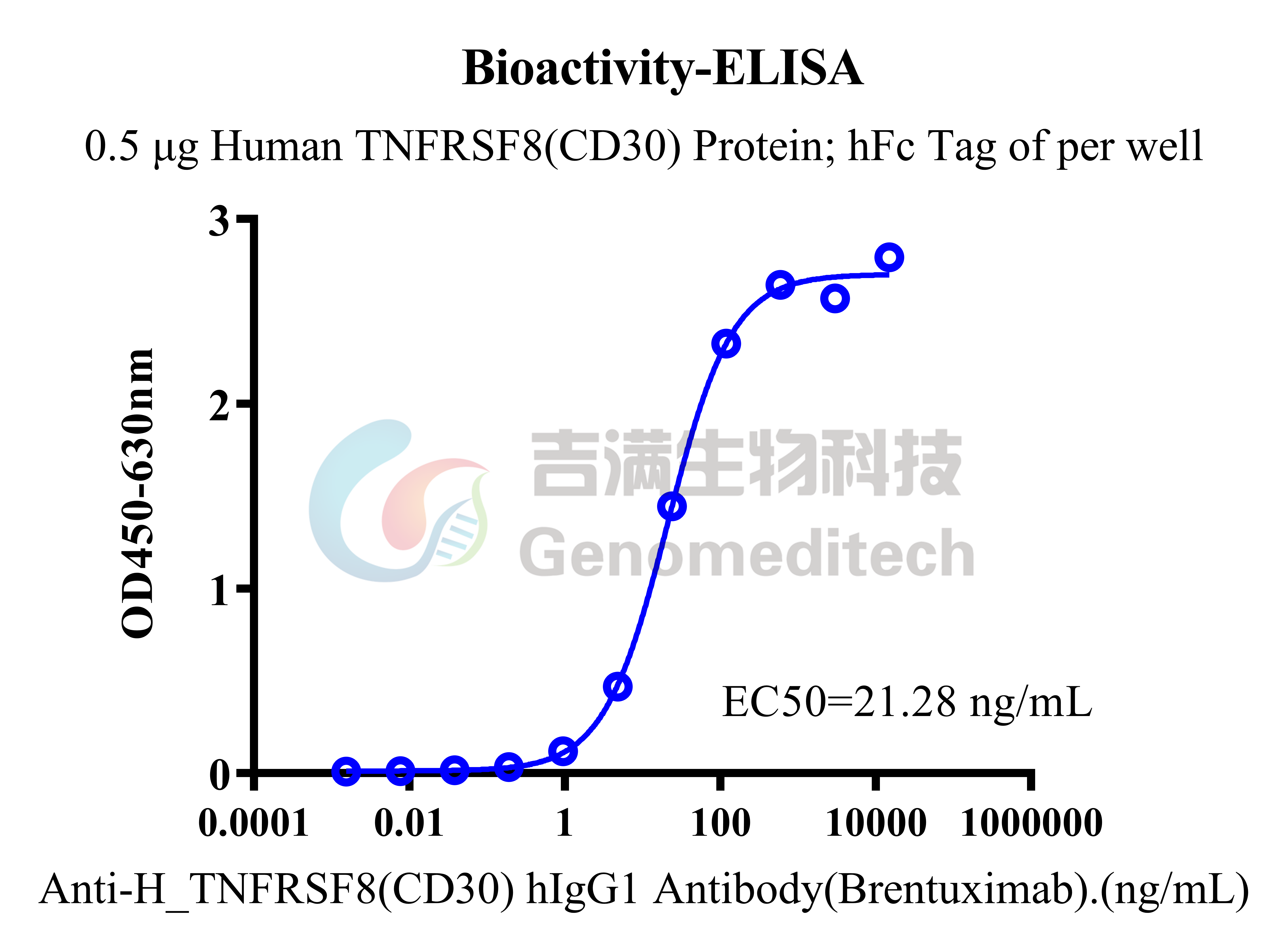
亲和力
相关产品
For laboratory research use only. Direct human use, including taking orally and injection and clinical use are forbidden.
Human TNFRSF8(CD30) Protein; hFc Tag
货号
GM-88427RP
规格
100 μg
1 mg
立即询价
产品简介
数据展示
相关产品
产品简介
Alternative Names TNFRSF8, CD30, D1S166E, Ki-1
Source Human TNFRSF8(CD30) Protein; hFc Tag (GM88427RP) is expressed from human 293 cells (HEK-293). It contains AA Phe 19 - Lys 379 (Accession # P28908-1).
This protein carries a hFc tag at the C-terminus.
Purity > 95% as determined by SDS-PAGE
Endotoxin < 1 EU/μg, determined by LAL gel clotting assay
Predicted Mol Mass 64.4 KDa
Formulation Supplied as a 0.2 μm filtered solution of PBS, pH7.2-7.4.
Description TNFRSF8, also known as CD30, is a type I transmembrane receptor in the tumor necrosis factor receptor (TNFR) superfamily. It is variably expressed on activated T cells, certain B cells, and a subset of malignancies such as Hodgkin lymphoma and anaplastic large cell lymphoma. CD30 functions as a co-stimulatory receptor involved in cell proliferation, survival, and differentiation signals. It is also used as a diagnostic and therapeutic target in CD30-positive diseases. Other aliases include D1S166E and Ki-1.
CD30 signaling is initiated upon trimerization or clustering of the receptor, leading to recruitment of adaptor proteins and activation of downstream pathways such as NF-κB, MAPK (ERK, JNK), and PI3K-Akt. This signaling promotes cell survival, proliferation, and cytokine production, particularly in activated T cells and certain neoplastic cells. Dysregulated CD30 signaling can contribute to pathologic immune responses and tumorigenesis, making CD30 a valuable target for monoclonal antibodies and targeted therapies.

Alternative Names TNFRSF8, CD30, D1S166E, Ki-1
Source Human TNFRSF8(CD30) Protein; hFc Tag (GM88427RP) is expressed from human 293 cells (HEK-293). It contains AA Phe 19 - Lys 379 (Accession # P28908-1).
This protein carries a hFc tag at the C-terminus.
Purity > 95% as determined by SDS-PAGE
Endotoxin < 1 EU/μg, determined by LAL gel clotting assay
Predicted Mol Mass 64.4 KDa
Formulation Supplied as a 0.2 μm filtered solution of PBS, pH7.2-7.4.
Description TNFRSF8, also known as CD30, is a type I transmembrane receptor in the tumor necrosis factor receptor (TNFR) superfamily. It is variably expressed on activated T cells, certain B cells, and a subset of malignancies such as Hodgkin lymphoma and anaplastic large cell lymphoma. CD30 functions as a co-stimulatory receptor involved in cell proliferation, survival, and differentiation signals. It is also used as a diagnostic and therapeutic target in CD30-positive diseases. Other aliases include D1S166E and Ki-1.
CD30 signaling is initiated upon trimerization or clustering of the receptor, leading to recruitment of adaptor proteins and activation of downstream pathways such as NF-κB, MAPK (ERK, JNK), and PI3K-Akt. This signaling promotes cell survival, proliferation, and cytokine production, particularly in activated T cells and certain neoplastic cells. Dysregulated CD30 signaling can contribute to pathologic immune responses and tumorigenesis, making CD30 a valuable target for monoclonal antibodies and targeted therapies.

数据展示
纯度
亲和力
相关产品
Tel: 400-627-9288
留言咨询
重置
提交
客服
微信
电话
留言
留言咨询
重置
提交