












| Alternative Names | IL4,BCGF1,BSF1 |
| Source | Cynomolgus IL-4 Protein; His Tag (GM-88464RP) is expressed from human 293 cells (HEK-293). It contains AA His 25 - Ser 153 (Accession # P79339-1). This protein carries a His tag at the C-terminus. |
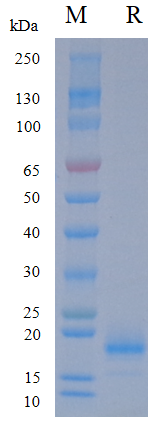
| Purity | > 90% as determined by SDS-PAGE |
| Endotoxin | < 1 EU/μg, determined by LAL gel clotting assay |
| Predicted Mol Mass | 15.8 KDa |
| Formulation | Supplied as a 0.2 μm filtered solution of PBS, pH7.2-7.4. |
| Description | Interleukin-4 (IL-4) is a key cytokine that plays an important role in regulating immune responses. It is mainly produced by helper T cells (especially Th2 cells), mast cells, and some other immune cells. IL-4 promotes the differentiation of B cells into antibody-producing cells, enhances type I immune responses, and suppresses Th1-mediated immune pathways. This is crucial for combating parasitic infections and modulating allergic reactions. Additionally, IL-4 is involved in maintaining immune system balance, promoting anti-inflammatory responses, and tissue repair. In clinical research, understanding IL-4 and its signaling pathway is significant for comprehending allergic diseases, autoimmune conditions, and developing related immunotherapies. Its functions extend beyond the immune system, influencing the growth and differentiation of blood cells and tissue cells. |
| Alternative Names | IL4,BCGF1,BSF1 |
| Source | Cynomolgus IL-4 Protein; His Tag (GM-88464RP) is expressed from human 293 cells (HEK-293). It contains AA His 25 - Ser 153 (Accession # P79339-1). This protein carries a His tag at the C-terminus. |
| Purity | > 90% as determined by SDS-PAGE |
| Endotoxin | < 1 EU/μg, determined by LAL gel clotting assay |
| Predicted Mol Mass | 15.8 KDa |
| Formulation | Supplied as a 0.2 μm filtered solution of PBS, pH7.2-7.4. |
| Description | Interleukin-4 (IL-4) is a key cytokine that plays an important role in regulating immune responses. It is mainly produced by helper T cells (especially Th2 cells), mast cells, and some other immune cells. IL-4 promotes the differentiation of B cells into antibody-producing cells, enhances type I immune responses, and suppresses Th1-mediated immune pathways. This is crucial for combating parasitic infections and modulating allergic reactions. Additionally, IL-4 is involved in maintaining immune system balance, promoting anti-inflammatory responses, and tissue repair. In clinical research, understanding IL-4 and its signaling pathway is significant for comprehending allergic diseases, autoimmune conditions, and developing related immunotherapies. Its functions extend beyond the immune system, influencing the growth and differentiation of blood cells and tissue cells. |