









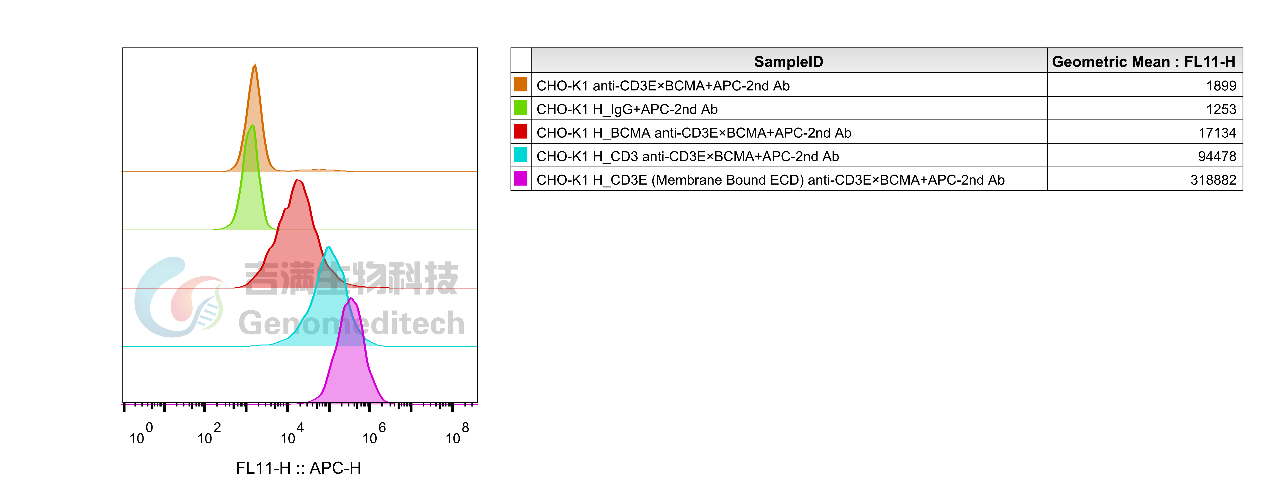





| Expression System | CHO |
| Aggregation | < 5% as determined by SEC-HPLC |
| Purity | > 95% as determined by SDS-PAGE |
| Species Reactivity | Human |
| Clone | teclistamab |
| Source/Isotype | Monoclonal Human hIgG4 (S228P/F234A/L235A) λ-2 |
| Application | Flow Cytometry; Aassay |
| Specificity | Detects CD3E & BCMA |
| Gene | CD3E & BCMA |
| Other Names | CD3E: CD3epsilon, IMD18, T3E, TCRE |
| Background | Teclistamab is a Bispecific monoclonal antibody that enhances the immune system's ability to attack cancer cells by targeting two different antigens at once. It specifically binds to B cell maturation antigen (BCMA) and CD3 molecules on the surface of T cells, forming a“Bridge” that enables T cells to recognize and contact myeloma cells more efficiently. When Teclistamab binds to CD3, it activates T cells, prompting them to release cytokines that mediate the killing of tumor cells and thus promote their death. In addition, Teclistamab directs T cells to the tumor microenvironment, further enhancing the body's anti-tumor immune response. This mechanism dramatically improves the effectiveness of Teclistamab in treating multiple myeloma. |
| Storage | Store at 2-8°C short term (1-2 weeks). Store at ≤ -20°C long term.Avoid repeated freeze-thaw. |
| Formulation | Phosphate-buffered solution, pH 7.2-7.4. |
| Endotoxin | < 1 EU/mg, determined by LAL gel clotting assay |
| Expression System | CHO |
| Aggregation | < 5% as determined by SEC-HPLC |
| Purity | > 95% as determined by SDS-PAGE |
| Species Reactivity | Human |
| Clone | teclistamab |
| Source/Isotype | Monoclonal Human hIgG4 (S228P/F234A/L235A) λ-2 |
| Application | Flow Cytometry; Aassay |
| Specificity | Detects CD3E & BCMA |
| Gene | CD3E & BCMA |
| Other Names | CD3E: CD3epsilon, IMD18, T3E, TCRE |
| Background | Teclistamab is a Bispecific monoclonal antibody that enhances the immune system's ability to attack cancer cells by targeting two different antigens at once. It specifically binds to B cell maturation antigen (BCMA) and CD3 molecules on the surface of T cells, forming a“Bridge” that enables T cells to recognize and contact myeloma cells more efficiently. When Teclistamab binds to CD3, it activates T cells, prompting them to release cytokines that mediate the killing of tumor cells and thus promote their death. In addition, Teclistamab directs T cells to the tumor microenvironment, further enhancing the body's anti-tumor immune response. This mechanism dramatically improves the effectiveness of Teclistamab in treating multiple myeloma. |
| Storage | Store at 2-8°C short term (1-2 weeks). Store at ≤ -20°C long term.Avoid repeated freeze-thaw. |
| Formulation | Phosphate-buffered solution, pH 7.2-7.4. |
| Endotoxin | < 1 EU/mg, determined by LAL gel clotting assay |