




Human EGFR Protein; hFc Tag
货号
GM-87563RP
规格
100 μg
1 mg
立即询价
产品简介
数据展示
相关产品
产品简介
Alternative Names EGFR, ERBB, ERBB1, HER1, PIG61, mENA
Source Human EGFR Protein; hFc Tag (GM-87563RP) is expressed from human 293 cells (HEK-293). It contains AA Leu 25 - Ser 645 (Accession # P00533-1).
This protein carries a hFc tag at the C-terminus.
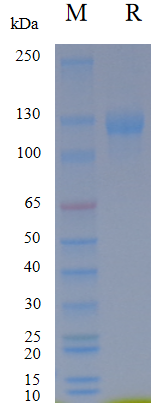
Purity > 95% as determined by SDS-PAGE
Endotoxin < 1 EU/μg, determined by LAL gel clotting assay
Predicted Mol Mass 94.5 KDa
Formulation Supplied as a 0.2 μm filtered solution of PBS, pH7.2-7.4.
Description EGFR (Epidermal Growth Factor Receptor) protein is a receptor tyrosine kinase (RTK), belonging to the tyrosine kinase receptor family. EGFR is widely expressed in various cell types, including epithelial cells, nerve cells, and muscle cells. Activation of EGFR typically occurs through binding to its ligand (such as EGF), triggering its autophosphorylation and activating its tyrosine kinase activity. Activated EGFR then initiates a series of signaling pathways, including Ras-MAPK, PI3K-Akt, among others, thereby influencing cell physiological functions.
EGFR plays a significant role in many types of cancers because abnormal EGFR signaling pathways can lead to excessive cell proliferation and malignant transformation. Therefore, EGFR has become one of the important targets for cancer treatment, with anti-cancer drugs targeting EGFR, such as EGFR inhibitors, being widely researched and applied in clinical therapy. EGFR holds importance in cell biology and cancer research, playing a crucial role in understanding cell signaling and cancer development mechanisms.

Alternative Names EGFR, ERBB, ERBB1, HER1, PIG61, mENA
Source Human EGFR Protein; hFc Tag (GM-87563RP) is expressed from human 293 cells (HEK-293). It contains AA Leu 25 - Ser 645 (Accession # P00533-1).
This protein carries a hFc tag at the C-terminus.
Purity > 95% as determined by SDS-PAGE
Endotoxin < 1 EU/μg, determined by LAL gel clotting assay
Predicted Mol Mass 94.5 KDa
Formulation Supplied as a 0.2 μm filtered solution of PBS, pH7.2-7.4.
Description EGFR (Epidermal Growth Factor Receptor) protein is a receptor tyrosine kinase (RTK), belonging to the tyrosine kinase receptor family. EGFR is widely expressed in various cell types, including epithelial cells, nerve cells, and muscle cells. Activation of EGFR typically occurs through binding to its ligand (such as EGF), triggering its autophosphorylation and activating its tyrosine kinase activity. Activated EGFR then initiates a series of signaling pathways, including Ras-MAPK, PI3K-Akt, among others, thereby influencing cell physiological functions.
EGFR plays a significant role in many types of cancers because abnormal EGFR signaling pathways can lead to excessive cell proliferation and malignant transformation. Therefore, EGFR has become one of the important targets for cancer treatment, with anti-cancer drugs targeting EGFR, such as EGFR inhibitors, being widely researched and applied in clinical therapy. EGFR holds importance in cell biology and cancer research, playing a crucial role in understanding cell signaling and cancer development mechanisms.

数据展示
纯度
亲和力
相关产品
For laboratory research use only. Direct human use, including taking orally and injection and clinical use are forbidden.
Human EGFR Protein; hFc Tag
货号
GM-87563RP
规格
100 μg
1 mg
立即询价
产品简介
数据展示
相关产品
产品简介
Alternative Names EGFR, ERBB, ERBB1, HER1, PIG61, mENA
Source Human EGFR Protein; hFc Tag (GM-87563RP) is expressed from human 293 cells (HEK-293). It contains AA Leu 25 - Ser 645 (Accession # P00533-1).
This protein carries a hFc tag at the C-terminus.
Purity > 95% as determined by SDS-PAGE
Endotoxin < 1 EU/μg, determined by LAL gel clotting assay
Predicted Mol Mass 94.5 KDa
Formulation Supplied as a 0.2 μm filtered solution of PBS, pH7.2-7.4.
Description EGFR (Epidermal Growth Factor Receptor) protein is a receptor tyrosine kinase (RTK), belonging to the tyrosine kinase receptor family. EGFR is widely expressed in various cell types, including epithelial cells, nerve cells, and muscle cells. Activation of EGFR typically occurs through binding to its ligand (such as EGF), triggering its autophosphorylation and activating its tyrosine kinase activity. Activated EGFR then initiates a series of signaling pathways, including Ras-MAPK, PI3K-Akt, among others, thereby influencing cell physiological functions.
EGFR plays a significant role in many types of cancers because abnormal EGFR signaling pathways can lead to excessive cell proliferation and malignant transformation. Therefore, EGFR has become one of the important targets for cancer treatment, with anti-cancer drugs targeting EGFR, such as EGFR inhibitors, being widely researched and applied in clinical therapy. EGFR holds importance in cell biology and cancer research, playing a crucial role in understanding cell signaling and cancer development mechanisms.

Alternative Names EGFR, ERBB, ERBB1, HER1, PIG61, mENA
Source Human EGFR Protein; hFc Tag (GM-87563RP) is expressed from human 293 cells (HEK-293). It contains AA Leu 25 - Ser 645 (Accession # P00533-1).
This protein carries a hFc tag at the C-terminus.
Purity > 95% as determined by SDS-PAGE
Endotoxin < 1 EU/μg, determined by LAL gel clotting assay
Predicted Mol Mass 94.5 KDa
Formulation Supplied as a 0.2 μm filtered solution of PBS, pH7.2-7.4.
Description EGFR (Epidermal Growth Factor Receptor) protein is a receptor tyrosine kinase (RTK), belonging to the tyrosine kinase receptor family. EGFR is widely expressed in various cell types, including epithelial cells, nerve cells, and muscle cells. Activation of EGFR typically occurs through binding to its ligand (such as EGF), triggering its autophosphorylation and activating its tyrosine kinase activity. Activated EGFR then initiates a series of signaling pathways, including Ras-MAPK, PI3K-Akt, among others, thereby influencing cell physiological functions.
EGFR plays a significant role in many types of cancers because abnormal EGFR signaling pathways can lead to excessive cell proliferation and malignant transformation. Therefore, EGFR has become one of the important targets for cancer treatment, with anti-cancer drugs targeting EGFR, such as EGFR inhibitors, being widely researched and applied in clinical therapy. EGFR holds importance in cell biology and cancer research, playing a crucial role in understanding cell signaling and cancer development mechanisms.

数据展示
纯度
亲和力
相关产品
Tel: 400-627-9288
留言咨询
重置
提交
客服
微信
电话
留言
留言咨询
重置
提交