





Human CD276(B7H3 2Ig) Protein; hFc Tag
货号
GM-88590RP
规格
100 μg
1 mg
立即询价
基本信息
数据展示
相关产品
基本信息
Alternative Names B7-H3,B7 homolog 3
Source Human CD276(B7H3 2Ig) Protein; hFc Tag (GM-88590RP) is expressed from human 293 cells (HEK-293). It contains AA Leu 29 - Pro 245 (Accession # Q5ZPR3-2).
This protein carries a hFc at the C-terminus.
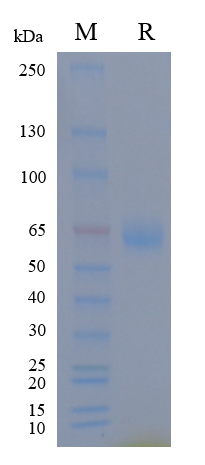
Purity > 95% as determined by SDS-PAGE
Endotoxin < 1 EU/μg, determined by LAL gel clotting assay
Predicted Mol Mass 49.3 kDa
Formulation Supplied as a 0.2 μm filtered solution of PBS, pH7.2-7.4.
Description CD276, also known as B7-H3 (2Ig isoform), is an immunoregulatory molecule that belongs to the B7 family of co-stimulatory proteins. It is encoded by the CD276 gene and is a type I transmembrane glycoprotein associated with the human immune system. CD276 protein was initially identified on antigen-presenting cells and later detected in various immune cell subsets, including T cells and NK cells, as well as in multiple solid tumor tissues. Unlike classic co-stimulatory molecules, CD276 exhibits dual functions: it can enhance T cell activation and cytokine production, but in the tumor microenvironment, it predominantly acts as a co-inhibitory molecule that suppresses T cell and NK cell-mediated anti-tumor immunity. T cells and NK cells are critical lymphocytes with essential roles in adaptive and innate immune responses, tumor surveillance, and cytokine secretion, making them central members of the immune system. Research indicates that CD276 protein plays a significant role in modulating immune tolerance, promoting tumor immune evasion, and regulating adaptive immune responses. Additionally, the overexpression of CD276 protein is associated with poor prognosis in various cancers, including non-small cell lung cancer and pancreatic cancer, as well as with inflammatory diseases and immune dysregulation, making it a promising therapeutic target for cancer immunotherapy, including antibody-drug conjugates (ADCs) and CAR-T cell therapies.
Alternative Names B7-H3,B7 homolog 3
Source Human CD276(B7H3 2Ig) Protein; hFc Tag (GM-88590RP) is expressed from human 293 cells (HEK-293). It contains AA Leu 29 - Pro 245 (Accession # Q5ZPR3-2).
This protein carries a hFc at the C-terminus.
Purity > 95% as determined by SDS-PAGE
Endotoxin < 1 EU/μg, determined by LAL gel clotting assay
Predicted Mol Mass 49.3 kDa
Formulation Supplied as a 0.2 μm filtered solution of PBS, pH7.2-7.4.
Description CD276, also known as B7-H3 (2Ig isoform), is an immunoregulatory molecule that belongs to the B7 family of co-stimulatory proteins. It is encoded by the CD276 gene and is a type I transmembrane glycoprotein associated with the human immune system. CD276 protein was initially identified on antigen-presenting cells and later detected in various immune cell subsets, including T cells and NK cells, as well as in multiple solid tumor tissues. Unlike classic co-stimulatory molecules, CD276 exhibits dual functions: it can enhance T cell activation and cytokine production, but in the tumor microenvironment, it predominantly acts as a co-inhibitory molecule that suppresses T cell and NK cell-mediated anti-tumor immunity. T cells and NK cells are critical lymphocytes with essential roles in adaptive and innate immune responses, tumor surveillance, and cytokine secretion, making them central members of the immune system. Research indicates that CD276 protein plays a significant role in modulating immune tolerance, promoting tumor immune evasion, and regulating adaptive immune responses. Additionally, the overexpression of CD276 protein is associated with poor prognosis in various cancers, including non-small cell lung cancer and pancreatic cancer, as well as with inflammatory diseases and immune dysregulation, making it a promising therapeutic target for cancer immunotherapy, including antibody-drug conjugates (ADCs) and CAR-T cell therapies.
数据展示
纯度
亲和力
相关产品
For laboratory research use only. Direct human use, including taking orally and injection and clinical use are forbidden.
Human CD276(B7H3 2Ig) Protein; hFc Tag
货号
GM-88590RP
规格
100 μg
1 mg
立即询价
基本信息
数据展示
相关产品
基本信息
Alternative Names B7-H3,B7 homolog 3
Source Human CD276(B7H3 2Ig) Protein; hFc Tag (GM-88590RP) is expressed from human 293 cells (HEK-293). It contains AA Leu 29 - Pro 245 (Accession # Q5ZPR3-2).
This protein carries a hFc at the C-terminus.
Purity > 95% as determined by SDS-PAGE
Endotoxin < 1 EU/μg, determined by LAL gel clotting assay
Predicted Mol Mass 49.3 kDa
Formulation Supplied as a 0.2 μm filtered solution of PBS, pH7.2-7.4.
Description CD276, also known as B7-H3 (2Ig isoform), is an immunoregulatory molecule that belongs to the B7 family of co-stimulatory proteins. It is encoded by the CD276 gene and is a type I transmembrane glycoprotein associated with the human immune system. CD276 protein was initially identified on antigen-presenting cells and later detected in various immune cell subsets, including T cells and NK cells, as well as in multiple solid tumor tissues. Unlike classic co-stimulatory molecules, CD276 exhibits dual functions: it can enhance T cell activation and cytokine production, but in the tumor microenvironment, it predominantly acts as a co-inhibitory molecule that suppresses T cell and NK cell-mediated anti-tumor immunity. T cells and NK cells are critical lymphocytes with essential roles in adaptive and innate immune responses, tumor surveillance, and cytokine secretion, making them central members of the immune system. Research indicates that CD276 protein plays a significant role in modulating immune tolerance, promoting tumor immune evasion, and regulating adaptive immune responses. Additionally, the overexpression of CD276 protein is associated with poor prognosis in various cancers, including non-small cell lung cancer and pancreatic cancer, as well as with inflammatory diseases and immune dysregulation, making it a promising therapeutic target for cancer immunotherapy, including antibody-drug conjugates (ADCs) and CAR-T cell therapies.
Alternative Names B7-H3,B7 homolog 3
Source Human CD276(B7H3 2Ig) Protein; hFc Tag (GM-88590RP) is expressed from human 293 cells (HEK-293). It contains AA Leu 29 - Pro 245 (Accession # Q5ZPR3-2).
This protein carries a hFc at the C-terminus.
Purity > 95% as determined by SDS-PAGE
Endotoxin < 1 EU/μg, determined by LAL gel clotting assay
Predicted Mol Mass 49.3 kDa
Formulation Supplied as a 0.2 μm filtered solution of PBS, pH7.2-7.4.
Description CD276, also known as B7-H3 (2Ig isoform), is an immunoregulatory molecule that belongs to the B7 family of co-stimulatory proteins. It is encoded by the CD276 gene and is a type I transmembrane glycoprotein associated with the human immune system. CD276 protein was initially identified on antigen-presenting cells and later detected in various immune cell subsets, including T cells and NK cells, as well as in multiple solid tumor tissues. Unlike classic co-stimulatory molecules, CD276 exhibits dual functions: it can enhance T cell activation and cytokine production, but in the tumor microenvironment, it predominantly acts as a co-inhibitory molecule that suppresses T cell and NK cell-mediated anti-tumor immunity. T cells and NK cells are critical lymphocytes with essential roles in adaptive and innate immune responses, tumor surveillance, and cytokine secretion, making them central members of the immune system. Research indicates that CD276 protein plays a significant role in modulating immune tolerance, promoting tumor immune evasion, and regulating adaptive immune responses. Additionally, the overexpression of CD276 protein is associated with poor prognosis in various cancers, including non-small cell lung cancer and pancreatic cancer, as well as with inflammatory diseases and immune dysregulation, making it a promising therapeutic target for cancer immunotherapy, including antibody-drug conjugates (ADCs) and CAR-T cell therapies.
数据展示
纯度
亲和力
相关产品
Tel: 400-627-9288
留言咨询
重置
提交
客服
微信
电话
留言
留言咨询
重置
提交