




Cynomolgus LY6G6D Protein; His Tag
货号
GM-88638RP
规格
100 μg
1 mg
立即询价
基本信息
数据展示
相关产品
基本信息
Alternative Names lymphocyte antigen 6 family member G6D, C6orf23, G6D, LY6-D, MEGT1, NG25
Source Cynomolgus LY6G6D Protein; His Tag (GM-88638RP) is expressed from human 293 cells (HEK-293). It contains AA Asn 20 - Ser 104 (Accession # WAK97502.1).
This protein carries a His tag at the N-terminus.
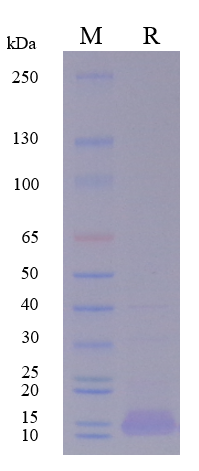
Purity > 95% as determined by SDS-PAGE
Endotoxin < 1 EU/μg, determined by LAL gel clotting assay
Predicted Mol Mass 10.0 kDa
Formulation Supplied as a 0.2 μm filtered solution of PBS, pH7.2-7.4.
Description LY6G6D protein, full name Lymphocyte Antigen 6 Family Member G6D, is an important cell surface protein and a member of the leukocyte antigen-6 (LY6) superfamily. LY6G6D protein is attached to the cell membrane by a glycosylphosphatidylinositol (GPI) anchor and plays a role in cell surface signaling in normal cells .
Abnormal expression of LY6G6D protein is closely associated with the occurrence and development of various malignant tumors, especially colorectal cancer (CRC). In tumor cells, overexpression of LY6G6D protein is particularly prevalent in the microsatellite stable (MSS) subtype of colorectal cancer, as well as in left-sided tumors and the canonical genomic subgroup, thereby serving as a promising tumor-associated antigen .
In summary, LY6G6D protein plays a crucial role in the occurrence and development of colorectal cancer, and is of great significance for understanding the pathogenesis of tumors, selecting targeted treatment strategies, and evaluating patient prognosis.
Alternative Names lymphocyte antigen 6 family member G6D, C6orf23, G6D, LY6-D, MEGT1, NG25
Source Cynomolgus LY6G6D Protein; His Tag (GM-88638RP) is expressed from human 293 cells (HEK-293). It contains AA Asn 20 - Ser 104 (Accession # WAK97502.1).
This protein carries a His tag at the N-terminus.
Purity > 95% as determined by SDS-PAGE
Endotoxin < 1 EU/μg, determined by LAL gel clotting assay
Predicted Mol Mass 10.0 kDa
Formulation Supplied as a 0.2 μm filtered solution of PBS, pH7.2-7.4.
Description LY6G6D protein, full name Lymphocyte Antigen 6 Family Member G6D, is an important cell surface protein and a member of the leukocyte antigen-6 (LY6) superfamily. LY6G6D protein is attached to the cell membrane by a glycosylphosphatidylinositol (GPI) anchor and plays a role in cell surface signaling in normal cells .
Abnormal expression of LY6G6D protein is closely associated with the occurrence and development of various malignant tumors, especially colorectal cancer (CRC). In tumor cells, overexpression of LY6G6D protein is particularly prevalent in the microsatellite stable (MSS) subtype of colorectal cancer, as well as in left-sided tumors and the canonical genomic subgroup, thereby serving as a promising tumor-associated antigen .
In summary, LY6G6D protein plays a crucial role in the occurrence and development of colorectal cancer, and is of great significance for understanding the pathogenesis of tumors, selecting targeted treatment strategies, and evaluating patient prognosis.
数据展示
纯度
亲和力
相关产品
For laboratory research use only. Direct human use, including taking orally and injection and clinical use are forbidden.
Cynomolgus LY6G6D Protein; His Tag
货号
GM-88638RP
规格
100 μg
1 mg
立即询价
基本信息
数据展示
相关产品
基本信息
Alternative Names lymphocyte antigen 6 family member G6D, C6orf23, G6D, LY6-D, MEGT1, NG25
Source Cynomolgus LY6G6D Protein; His Tag (GM-88638RP) is expressed from human 293 cells (HEK-293). It contains AA Asn 20 - Ser 104 (Accession # WAK97502.1).
This protein carries a His tag at the N-terminus.
Purity > 95% as determined by SDS-PAGE
Endotoxin < 1 EU/μg, determined by LAL gel clotting assay
Predicted Mol Mass 10.0 kDa
Formulation Supplied as a 0.2 μm filtered solution of PBS, pH7.2-7.4.
Description LY6G6D protein, full name Lymphocyte Antigen 6 Family Member G6D, is an important cell surface protein and a member of the leukocyte antigen-6 (LY6) superfamily. LY6G6D protein is attached to the cell membrane by a glycosylphosphatidylinositol (GPI) anchor and plays a role in cell surface signaling in normal cells .
Abnormal expression of LY6G6D protein is closely associated with the occurrence and development of various malignant tumors, especially colorectal cancer (CRC). In tumor cells, overexpression of LY6G6D protein is particularly prevalent in the microsatellite stable (MSS) subtype of colorectal cancer, as well as in left-sided tumors and the canonical genomic subgroup, thereby serving as a promising tumor-associated antigen .
In summary, LY6G6D protein plays a crucial role in the occurrence and development of colorectal cancer, and is of great significance for understanding the pathogenesis of tumors, selecting targeted treatment strategies, and evaluating patient prognosis.
Alternative Names lymphocyte antigen 6 family member G6D, C6orf23, G6D, LY6-D, MEGT1, NG25
Source Cynomolgus LY6G6D Protein; His Tag (GM-88638RP) is expressed from human 293 cells (HEK-293). It contains AA Asn 20 - Ser 104 (Accession # WAK97502.1).
This protein carries a His tag at the N-terminus.
Purity > 95% as determined by SDS-PAGE
Endotoxin < 1 EU/μg, determined by LAL gel clotting assay
Predicted Mol Mass 10.0 kDa
Formulation Supplied as a 0.2 μm filtered solution of PBS, pH7.2-7.4.
Description LY6G6D protein, full name Lymphocyte Antigen 6 Family Member G6D, is an important cell surface protein and a member of the leukocyte antigen-6 (LY6) superfamily. LY6G6D protein is attached to the cell membrane by a glycosylphosphatidylinositol (GPI) anchor and plays a role in cell surface signaling in normal cells .
Abnormal expression of LY6G6D protein is closely associated with the occurrence and development of various malignant tumors, especially colorectal cancer (CRC). In tumor cells, overexpression of LY6G6D protein is particularly prevalent in the microsatellite stable (MSS) subtype of colorectal cancer, as well as in left-sided tumors and the canonical genomic subgroup, thereby serving as a promising tumor-associated antigen .
In summary, LY6G6D protein plays a crucial role in the occurrence and development of colorectal cancer, and is of great significance for understanding the pathogenesis of tumors, selecting targeted treatment strategies, and evaluating patient prognosis.
数据展示
纯度
亲和力
相关产品
Tel: 400-627-9288
留言咨询
重置
提交
客服
微信
电话
留言
留言咨询
重置
提交