









| Alternative Names | FAP, FAPalpha, SIMP, Seprase, APCE |
| Source | Human FAP Protein; His Tag (GM-88563RP) is expressed from human 293 cells (HEK-293). It contains AA Leu 26 - Asp 760 (Accession # Q12884-1). This protein carries a His tag at the N-terminus. |
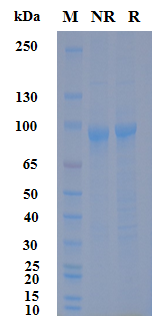
| Purity | > 90% as determined by SDS-PAGE |
| Endotoxin | < 1 EU/μg, determined by LAL gel clotting assay |
| Predicted Mol Mass | 85.8 KDa |
| Formulation | Supplied as a 0.2 μm filtered solution of PBS, pH7.2-7.4. |
| Description | FAP (fibroblast activation protein) is a type II transmembrane serine protease predominantly expressed on activated fibroblasts in tumor stroma and fibrotic tissues, while being largely absent from most normal adult tissues. It exhibits both dipeptidyl peptidase and endopeptidase activities and plays a key role in extracellular matrix remodeling, tissue repair, and the regulation of the local microenvironment. By degrading matrix components and processing bioactive peptides, FAP can promote tumor growth, invasion, angiogenesis, and the development of organ fibrosis.Beyond its role in tissue remodeling, FAP contributes to shaping immune responses and stromal–tumor interactions, influencing immune cell infiltration, cytokine milieu, and drug penetration in solid tumors. In the context of cancer, fibrosis, and chronic inflammatory disease, modulation of the FAP pathway has important implications for targeted therapy, stromal reprogramming, and molecular imaging. Recombinant Human FAP Protein is widely used in studies of FAP enzymatic activity, substrate profiling, inhibitor screening, and in the development or functional evaluation of FAP‑directed diagnostic and therapeutic agents, including small‑molecule inhibitors, antibody‑based therapies, and radioligand tracers. |
| Alternative Names | FAP, FAPalpha, SIMP, Seprase, APCE |
| Source | Human FAP Protein; His Tag (GM-88563RP) is expressed from human 293 cells (HEK-293). It contains AA Leu 26 - Asp 760 (Accession # Q12884-1). This protein carries a His tag at the N-terminus. |
| Purity | > 90% as determined by SDS-PAGE |
| Endotoxin | < 1 EU/μg, determined by LAL gel clotting assay |
| Predicted Mol Mass | 85.8 KDa |
| Formulation | Supplied as a 0.2 μm filtered solution of PBS, pH7.2-7.4. |
| Description | FAP (fibroblast activation protein) is a type II transmembrane serine protease predominantly expressed on activated fibroblasts in tumor stroma and fibrotic tissues, while being largely absent from most normal adult tissues. It exhibits both dipeptidyl peptidase and endopeptidase activities and plays a key role in extracellular matrix remodeling, tissue repair, and the regulation of the local microenvironment. By degrading matrix components and processing bioactive peptides, FAP can promote tumor growth, invasion, angiogenesis, and the development of organ fibrosis.Beyond its role in tissue remodeling, FAP contributes to shaping immune responses and stromal–tumor interactions, influencing immune cell infiltration, cytokine milieu, and drug penetration in solid tumors. In the context of cancer, fibrosis, and chronic inflammatory disease, modulation of the FAP pathway has important implications for targeted therapy, stromal reprogramming, and molecular imaging. Recombinant Human FAP Protein is widely used in studies of FAP enzymatic activity, substrate profiling, inhibitor screening, and in the development or functional evaluation of FAP‑directed diagnostic and therapeutic agents, including small‑molecule inhibitors, antibody‑based therapies, and radioligand tracers. |