










| Alternative Names | CEACAM-5,CD66e,CEA,Meconium antigen 100 |
| Source | Human CEACAM5 Protein; hFc Tag (GM-87545RP) is expressed from human 293 cells (HEK-293). It contains AA Lys 35 - Ala 685 (Accession # P06731). This protein carries a human IgG1 Fc tag at the C-terminus. |
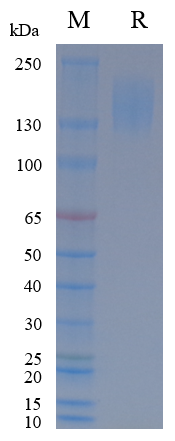
| Purity | > 95% as determined by SDS-PAGE |
| Endotoxin | < 1 EU/μg, determined by LAL gel clotting assay |
| Predicted Mol Mass | 97.3 KDa |
| Formulation | Supplied as a 0.2 μm filtered solution of PBS, pH7.2-7.4. |
| Description | CEACAM5 (Carcinoembryonic Antigen-Related Cell Adhesion Molecule 5) is a cell adhesion molecule and a member of the CEA family. CEACAM5 protein is mainly expressed in epithelial cells of the digestive tract and some cancer cells in the human body, including tissues such as the colon, rectum, and stomach. CEACAM5 protein plays an important role in cell adhesion and signal transduction between cells. It can interact with other cell surface CEACAM proteins or other cell adhesion molecules to participate in cell adhesion and interactions. Additionally, CEACAM5 protein can activate signal transduction pathways to regulate biological processes such as cell proliferation, migration, and apoptosis. Due to its high expression in many cancers, CEACAM5 protein is considered a tumor marker. Clinically, the expression level of CEACAM5 protein can be used to assess the degree of tumor development, prognosis, and treatment effects. Some studies also suggest that CEACAM5 protein may be involved in the occurrence and development of tumors, making it a potential target for cancer treatment. |
| Alternative Names | CEACAM-5,CD66e,CEA,Meconium antigen 100 |
| Source | Human CEACAM5 Protein; hFc Tag (GM-87545RP) is expressed from human 293 cells (HEK-293). It contains AA Lys 35 - Ala 685 (Accession # P06731). This protein carries a human IgG1 Fc tag at the C-terminus. |
| Purity | > 95% as determined by SDS-PAGE |
| Endotoxin | < 1 EU/μg, determined by LAL gel clotting assay |
| Predicted Mol Mass | 97.3 KDa |
| Formulation | Supplied as a 0.2 μm filtered solution of PBS, pH7.2-7.4. |
| Description | CEACAM5 (Carcinoembryonic Antigen-Related Cell Adhesion Molecule 5) is a cell adhesion molecule and a member of the CEA family. CEACAM5 protein is mainly expressed in epithelial cells of the digestive tract and some cancer cells in the human body, including tissues such as the colon, rectum, and stomach. CEACAM5 protein plays an important role in cell adhesion and signal transduction between cells. It can interact with other cell surface CEACAM proteins or other cell adhesion molecules to participate in cell adhesion and interactions. Additionally, CEACAM5 protein can activate signal transduction pathways to regulate biological processes such as cell proliferation, migration, and apoptosis. Due to its high expression in many cancers, CEACAM5 protein is considered a tumor marker. Clinically, the expression level of CEACAM5 protein can be used to assess the degree of tumor development, prognosis, and treatment effects. Some studies also suggest that CEACAM5 protein may be involved in the occurrence and development of tumors, making it a potential target for cancer treatment. |