









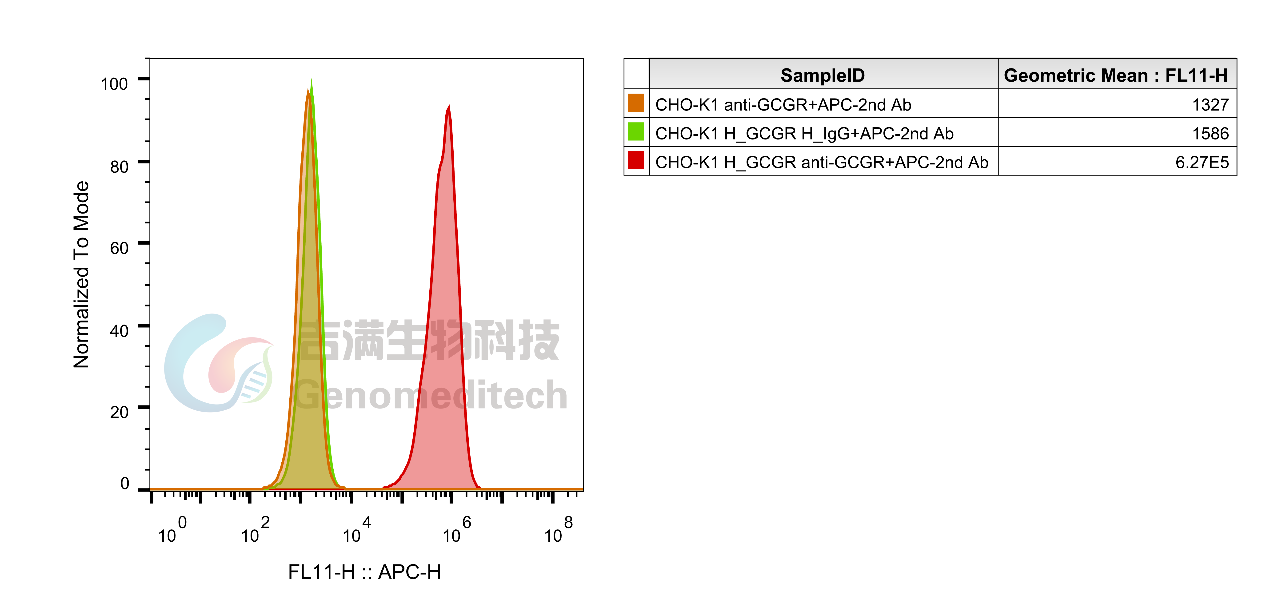




| Species Reactivity | Human; |
| Clone | H4H1327P |
| Source/Isotype | Monoclonal human IgG1, κ |
| Application | Flow cytometry; |
| Specificity | Detects GCGR |
| Gene | GCGR |
| Other Names | GGR, GL-R, MVAH |
| Gene ID | 2642 (human); |
| Background | The glucagon receptor (GCGR) is a G protein-coupled receptor primarily expressed in the liver and adrenal cortex. It plays a crucial role in regulating blood glucose levels and fat metabolism. Research on GCGR contributes to a better understanding of the pathophysiology of metabolic diseases such as diabetes and obesity, providing a theoretical basis for the development of relevant drugs. Studies on GCGR often involve investigating its signaling pathways, ligand binding mechanisms, and interactions with other receptors. |
| Storage | Store at 2-8℃ short term (1-2 weeks).Store at ≤ -20℃ long term. Avoid repeated freeze-thaw. |
| Formulation | Phosphate-buffered solution, pH 7.2. |
| Endotoxin | < 1 EU/mg, determined by LAL gel clotting assay |
| Species Reactivity | Human; |
| Clone | H4H1327P |
| Source/Isotype | Monoclonal human IgG1, κ |
| Application | Flow cytometry; |
| Specificity | Detects GCGR |
| Gene | GCGR |
| Other Names | GGR, GL-R, MVAH |
| Gene ID | 2642 (human); |
| Background | The glucagon receptor (GCGR) is a G protein-coupled receptor primarily expressed in the liver and adrenal cortex. It plays a crucial role in regulating blood glucose levels and fat metabolism. Research on GCGR contributes to a better understanding of the pathophysiology of metabolic diseases such as diabetes and obesity, providing a theoretical basis for the development of relevant drugs. Studies on GCGR often involve investigating its signaling pathways, ligand binding mechanisms, and interactions with other receptors. |
| Storage | Store at 2-8℃ short term (1-2 weeks).Store at ≤ -20℃ long term. Avoid repeated freeze-thaw. |
| Formulation | Phosphate-buffered solution, pH 7.2. |
| Endotoxin | < 1 EU/mg, determined by LAL gel clotting assay |