






产品编号:GM-46303AB
产品名称:Anti-H_LGR5 hIgG1 Antibody(18G7H6A3)
目录价:询价






产品编号:GM-46303AB
产品名称:Anti-H_LGR5 hIgG1 Antibody(18G7H6A3)
目录价:询价
GM-46303AB-10 10 μg
GM-46303AB-100 100 μg
GM-46303AB-1000 1mg
Species Reactivity Human; Cynomolgus
Clone 18G7H6A3
Source/Isotype Monoclonal Human IgG1 /κ
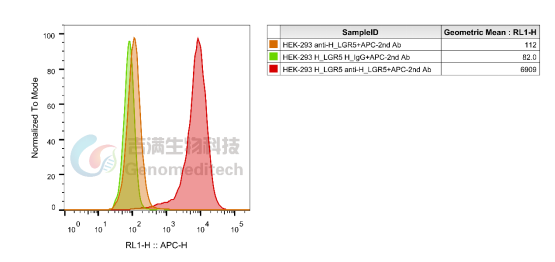
Application Flow cytometry
Specificity Detects LGR5
Gene LGR5
Other Names FEX; HG38; GPR49; GPR67; GRP49
Gene ID 8549
Background The protein encoded by this gene is a leucine-rich repeat-containing receptor (LGR) and member of the G protein-coupled, 7-transmembrane receptor (GPCR) superfamily. The encoded protein is a receptor for R-spondins and is involved in the canonical Wnt signaling pathway. Although its ligand remains elusive, it has been shown that costimulation with R-spondin 1 and Wnt-3a induce increased internalization of LGR5. LGR5 also cointernalizes with LRP6 and FZD5 via a clathrin-dependent pathway to form a ternary complex upon Wnt ligand binding. Moreover, the rapid cointernalization of LRP6 by LGR5 induces faster rates of degradation for the former. It has been shown that the C-terminal region of LGR5 is crucial for both dynamic internalization and degradation to occur, although C-terminal truncation does not inhibit LRP6 interaction and internalization, but rather, heightens receptor activity. Thus, only the initial interaction with its unknown ligand and other membrane bound receptors is crucial in its role in Wnt signalling and not the internalization itself.[10] LGR5 is crucial during embryogenesis as LGR null studies in mice incurred 100% neonatal mortality accompanied by several craniofacial distortions such as ankyloglossia and gastrointestinal dilation.
Storage Store at 2-8℃ short term (1-2 weeks).Store at ≤ -20℃ long term. Avoid repeated freeze-thaw.
Formulation Phosphate-buffered solution, pH 7.2.
Endotoxin < 1 EU/mg, determined by LAL gel clotting assay

产品编号:GM-46303AB
产品名称:Anti-H_LGR5 hIgG1 Antibody(18G7H6A3)
目录价:询价
产品编号:GM-46303AB
产品名称:Anti-H_LGR5 hIgG1 Antibody(18G7H6A3)
目录价:询价
GM-46303AB-10 10 μg
GM-46303AB-100 100 μg
GM-46303AB-1000 1mg
GM-46303AB-10 10 μg
GM-46303AB-100 100 μg
GM-46303AB-1000 1mg
Species Reactivity Human; Cynomolgus
Clone 18G7H6A3
Source/Isotype Monoclonal Human IgG1 /κ
Application Flow cytometry
Specificity Detects LGR5
Gene LGR5
Other Names FEX; HG38; GPR49; GPR67; GRP49
Gene ID 8549
Background The protein encoded by this gene is a leucine-rich repeat-containing receptor (LGR) and member of the G protein-coupled, 7-transmembrane receptor (GPCR) superfamily. The encoded protein is a receptor for R-spondins and is involved in the canonical Wnt signaling pathway. Although its ligand remains elusive, it has been shown that costimulation with R-spondin 1 and Wnt-3a induce increased internalization of LGR5. LGR5 also cointernalizes with LRP6 and FZD5 via a clathrin-dependent pathway to form a ternary complex upon Wnt ligand binding. Moreover, the rapid cointernalization of LRP6 by LGR5 induces faster rates of degradation for the former. It has been shown that the C-terminal region of LGR5 is crucial for both dynamic internalization and degradation to occur, although C-terminal truncation does not inhibit LRP6 interaction and internalization, but rather, heightens receptor activity. Thus, only the initial interaction with its unknown ligand and other membrane bound receptors is crucial in its role in Wnt signalling and not the internalization itself.[10] LGR5 is crucial during embryogenesis as LGR null studies in mice incurred 100% neonatal mortality accompanied by several craniofacial distortions such as ankyloglossia and gastrointestinal dilation.
Storage Store at 2-8℃ short term (1-2 weeks).Store at ≤ -20℃ long term. Avoid repeated freeze-thaw.
Formulation Phosphate-buffered solution, pH 7.2.
Endotoxin < 1 EU/mg, determined by LAL gel clotting assay
Species Reactivity Human; Cynomolgus
Clone 18G7H6A3
Source/Isotype Monoclonal Human IgG1 /κ
Application Flow cytometry
Specificity Detects LGR5
Gene LGR5
Other Names FEX; HG38; GPR49; GPR67; GRP49
Gene ID 8549
Background The protein encoded by this gene is a leucine-rich repeat-containing receptor (LGR) and member of the G protein-coupled, 7-transmembrane receptor (GPCR) superfamily. The encoded protein is a receptor for R-spondins and is involved in the canonical Wnt signaling pathway. Although its ligand remains elusive, it has been shown that costimulation with R-spondin 1 and Wnt-3a induce increased internalization of LGR5. LGR5 also cointernalizes with LRP6 and FZD5 via a clathrin-dependent pathway to form a ternary complex upon Wnt ligand binding. Moreover, the rapid cointernalization of LRP6 by LGR5 induces faster rates of degradation for the former. It has been shown that the C-terminal region of LGR5 is crucial for both dynamic internalization and degradation to occur, although C-terminal truncation does not inhibit LRP6 interaction and internalization, but rather, heightens receptor activity. Thus, only the initial interaction with its unknown ligand and other membrane bound receptors is crucial in its role in Wnt signalling and not the internalization itself.[10] LGR5 is crucial during embryogenesis as LGR null studies in mice incurred 100% neonatal mortality accompanied by several craniofacial distortions such as ankyloglossia and gastrointestinal dilation.
Storage Store at 2-8℃ short term (1-2 weeks).Store at ≤ -20℃ long term. Avoid repeated freeze-thaw.
Formulation Phosphate-buffered solution, pH 7.2.
Endotoxin < 1 EU/mg, determined by LAL gel clotting assay