










| Alternative Names | BTN3A1,CD277,BTF5 |
| Source | Human BTN3A1 Protein; His Tag (GM-88576RP) is expressed from human 293 cells (HEK-293). It contains AA Gln 30 - Gly 254 (Accession # O00481-1). This protein carries a His tag at the C-terminus. |
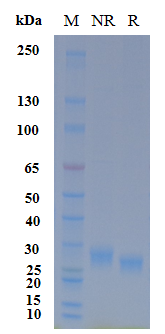
| Purity | > 95% as determined by SDS-PAGE |
| Endotoxin | < 1 EU/μg, determined by LAL gel clotting assay |
| Predicted Mol Mass | 25.0 KDa |
| Formulation | Supplied as a 0.2 μm filtered solution of PBS, pH7.2-7.4. |
| Description | BTN3A1 (butyrophilin subfamily 3 member A1, also known as CD277) is an immunoregulatory receptor belonging to the BTN/BTNL family within the extended B7 superfamily. It is broadly expressed on antigen-presenting cells, many hematopoietic cells, and various epithelial and tumor cells. BTN3A1 plays a pivotal role in modulating both innate and adaptive immunity, most notably by controlling the activation of human Vγ9Vδ2 cells. Through its intracellular B30.2 domain, BTN3A1 senses phosphoantigens derived from microbes or dysregulated cell metabolism and transduces conformational changes to the cell surface, thereby triggering Vγ9Vδ2 cell activation, cytokine production, and cytotoxic responses. Beyond phosphoantigen sensing, BTN3A1 contributes to the fine-tuning of T-cell responses, influencing immune surveillance, tolerance, and inflammation within the tumor microenvironment, autoimmune settings, and chronic infection. Dysregulation of BTN3A1 signaling has important implications for cancer immunotherapy and γδ T-cell-based therapies. Recombinant Human BTN3A1 Protein with a His tag is widely used to study BTN3A1 ligand interactions, phosphoantigen dependent γδ T-cell activation, and downstream signaling pathways. It also serves as a valuable reagent for antibody discovery and functional characterization, assay development, and the evaluation of novel immunotherapeutic strategies targeting the BTN3A1/γδ T-cell axis. |
| Alternative Names | BTN3A1,CD277,BTF5 |
| Source | Human BTN3A1 Protein; His Tag (GM-88576RP) is expressed from human 293 cells (HEK-293). It contains AA Gln 30 - Gly 254 (Accession # O00481-1). This protein carries a His tag at the C-terminus. |
| Purity | > 95% as determined by SDS-PAGE |
| Endotoxin | < 1 EU/μg, determined by LAL gel clotting assay |
| Predicted Mol Mass | 25.0 KDa |
| Formulation | Supplied as a 0.2 μm filtered solution of PBS, pH7.2-7.4. |
| Description | BTN3A1 (butyrophilin subfamily 3 member A1, also known as CD277) is an immunoregulatory receptor belonging to the BTN/BTNL family within the extended B7 superfamily. It is broadly expressed on antigen-presenting cells, many hematopoietic cells, and various epithelial and tumor cells. BTN3A1 plays a pivotal role in modulating both innate and adaptive immunity, most notably by controlling the activation of human Vγ9Vδ2 cells. Through its intracellular B30.2 domain, BTN3A1 senses phosphoantigens derived from microbes or dysregulated cell metabolism and transduces conformational changes to the cell surface, thereby triggering Vγ9Vδ2 cell activation, cytokine production, and cytotoxic responses. Beyond phosphoantigen sensing, BTN3A1 contributes to the fine-tuning of T-cell responses, influencing immune surveillance, tolerance, and inflammation within the tumor microenvironment, autoimmune settings, and chronic infection. Dysregulation of BTN3A1 signaling has important implications for cancer immunotherapy and γδ T-cell-based therapies. Recombinant Human BTN3A1 Protein with a His tag is widely used to study BTN3A1 ligand interactions, phosphoantigen dependent γδ T-cell activation, and downstream signaling pathways. It also serves as a valuable reagent for antibody discovery and functional characterization, assay development, and the evaluation of novel immunotherapeutic strategies targeting the BTN3A1/γδ T-cell axis. |